

My Comments: Two days ago I posted Annuities: Part One. In this post my attempt is to expand on a readers understanding of annuities in general so that if anyone sees this as a viable way to set aside money for the future, they’ll have a better understanding of the variables involved and how they might position their money for future use.
by Tony Kendzior, CLU, ChFC / 30 AUG 2023
Qualified or Non-Qualified Annuities
The term “qualified” refers to the IRS regulations that identify money that has or has not been taxed as income. It’s often referred to as before-tax income and after-tax Income. “Qualified” accounts are funded with money that hasn’t yet been taxed and has met the IRS requirements for being considered as “qualified” money for income tax purposes. Examples of this are pension plans, IRA’s, 401K plans and so on. Money going into an account of any kind designed for this outcome is referred to as a “qualified” account. In contrast, a non-qualified annuity is one funded with after-tax money.
Any type of deferred annuity, be it fixed, variable, or indexed, can be used informally to accumulate assets on a tax-deferred basis for the long term. Or it can be used formally as the funding vehicle for a qualified plan, such as an IRA or SEP. The former are nonqualified annuities; the latter are qualified annuities.
Different Rules for Qualified vs. Nonqualified
Qualified annuities and nonqualified annuities share the same product features and benefits; however, the rules under which each operates are different.
For example, an individual who purchases a nonqualified annuity cannot deduct the premium deposits. Contrast this with an individual who purchases an annuity to fund a traditional IRA. The person should be able to deduct the premium payments depending on income level and whether he or she is also participating in an employer sponsored plan. The individual who owns a nonqualified annuity may make premium deposits in any amount he or she wishes with after-tax money, while an individual who owns a qualified annuity is limited in the amount of premium deposit possible in any given tax year as determined by the IRS
Any type of annuity can be used to fund a qualified plan; when used for this purpose, the annuity is then subject to the same rules that apply to the qualified plan, whether individual or employer sponsored.
Should Annuities Be Used to Fund a Qualified Plan?
Using annuities to fund qualified accounts is controversial. Critics correctly point out that the annuity’s tax-deferral benefit is redundant because qualified plans, by definition, provide for tax deferral. For this feature, an annuity offers no additional benefit over other funding instruments, such as mutual funds. In addition, annuities impose charges and fees that other investment products do not. Why, then, should investors put one tax-deferred instrument such as an annuity into another, a qualified plan. There has to be an accounting of which costs more than others.
One reason, especially for those who are risk averse, is that annuities offer unique benefits other than tax deferral. These include:
- a guaranteed death benefit
- a means to generate a guaranteed lifelong income stream
- a variety of options for the payout of the income stream
If the product is a fixed annuity, the owner’s principal is secure and is guaranteed by the insurer. If the product is a variable annuity, the owner is able to direct his or her premium deposits into a variety of investment subaccount options and potentially achieve better diversification.
Many variable annuities now offer innovative options that can guarantee certain accumulation amounts or certain minimum income payments. For those who do not need or want these additional benefits, using an annuity to fund a qualified plan may not be appropriate. Furthermore, those who can participate in a 401(k) plan or SIMPLE plan that provides for matching employer contributions should maximize contributions to such a plan before contributing to any individual qualified annuity.
Roth IRAs, funded with appropriate investments, should also be considered, because the earnings on these vehicles are not subject to taxation at all as long as the owner maintains the account for the required number of years and meets the rules and regulations which determine how much a person can add to the account annually.
For others, the additional benefits offered by annuities could fit their situations, and these products could be suitable funding instruments for a qualified plan. It depends on the individual’s objectives and needs. Like any savings or investment product, an annuity’s features, benefits, costs, and limitations must align with the needs of the buyer.
The specifics of an annuity are set forth in the form of a contract. The contract specifies the details of the product and each contracting party’s obligations or responsibilities. For example, the contract will outline the annuity’s purchase payment provisions, any provisions for payment of a death benefit, annuitization options, contract assignments, contract terminations, etc.
Normally, there are four parties associated with an annuity contract: the insurer, the owner, the annuitant, and the beneficiary.
- The Insurer
Though they are marketed through a variety of distribution channels, annuities are issued by insurance companies. The insurer invests the premium payments, credits the interest earnings, tracks the contract’s growth and accumulation, and pays the benefits and possible withdrawals. It is the insurance company and its financial strength that stands behind any guarantees the contract provides.
An insurance company’s ratings are an indicator of its financial strength and ability to meet its contractual obligations. Both producers and consumers should consider a company’s ratings before recommending or purchasing an annuity. The following chart reflects possible insurer ratings, mindful there are additional ratings missing from the bottom. There is, in my opinion, no reason to ever consider purchasing any annuity contract from any company without one of the A ratings.
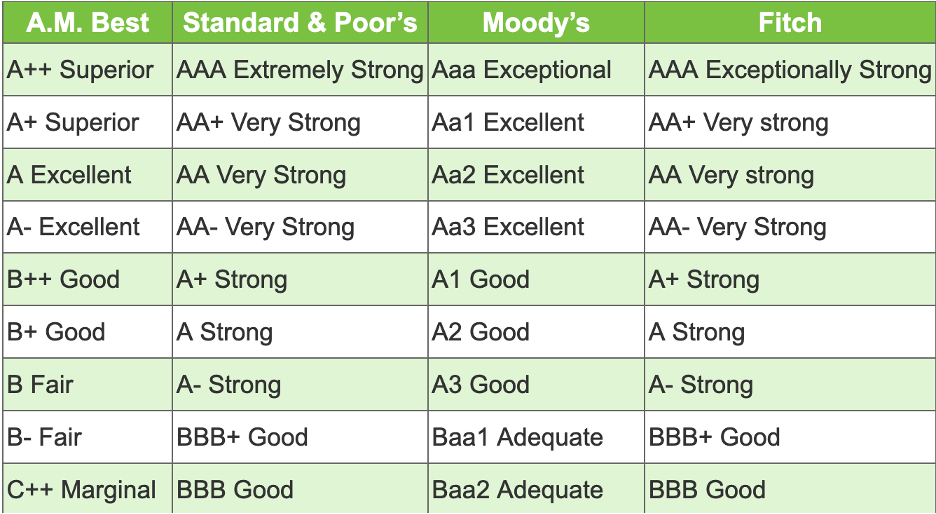
These are the rating scales of the top four ratings agencies: A.M.Best, Standard and Poor’s, Moody’s and Fitch.
- The Owner
The owner of an annuity contract is the person who has all rights under the contract before the scheduled annuitization date. Typically, the owner is the party who purchases the contract and makes the premium deposits. An annuity owner receives all rights and privileges under the contract and assumes all financial responsibilities.
For example, the owner:
- applies for and signs the annuity application, accepting the contract and its provisions
- designates the annuitant and the beneficiary
- receives the benefit of tax deferral
- specifies the contract’s annuitization date and period (The owner decides when annuity payments will begin and selects the contract’s payout option, which determines how long the payments will last.)
- has the right to periodically change the chosen index mix available to the specific FIA purchased.
If the contract is a variable annuity, the owner
- can make contract withdrawals
- can choose to liquidate or surrender the contract before the annuitization date
- can authorize changes to the contract (For instance, the owner can change the beneficiary [if the original beneficiary had not been named irrevocably]; can adjust or change the investment allocation of a variable annuity; and can change the scheduled annuity start date.)
- can assign the contract or even designate a new owner
- assumes liability for taxes owed on withdrawals and payouts
A number of insurance companies allow their annuity contracts to be purchased jointly and issued to two owners. Such arrangements, however, are usually limited to spouses. Both joint owners must sign the application. Each joint owner is authorized to make changes within the contract, but typically both must consent to the changes. Trusts can also own annuities which simply means the above applies to the trustee(s). Once annuitization begins, the contract is in a liquidation mode and typically, the owner’s rights end.
- The Annuitant
The annuitant is the person on whose life expectancy the annuity income payments are based and to whom the payments will likely be made. Quite frequently, the owner and the annuitant are the same person. Annuities can have joint annuitants, i.e., two individuals, such as a husband and wife. When this happens, the annuity income is typically structured so that payments are made for as long as either lives.
- The Beneficiary
The beneficiary is the person named who will receive the contract’s death benefit proceeds, should the owner or annuitant die before the contract’s values have been annuitized or before the contract’s starting date (i.e., the date the contract is scheduled to annuitize).
All annuity contracts provide for a death benefit but vary on whose death triggers this benefit: the owner or the annuitant. Annuity contracts that are owner-driven pay the death benefit when the owner dies. Contracts that are annuitant-driven pay the death benefit when either the owner or annuitant dies. The beneficiary of an annuity has no rights in the contract before the owner or annuitant dies.
Summary of Annuities: Part Two
In addition to providing a means to accumulate and/or distribute funds, annuities are characterized by a variety of features that make them unique, and complicated, financial planning tools.
Generally speaking, virtually all types of annuities provide the following features or benefits:
- tax deferral
- death benefits
- flexible funding
- variety of annuitized payout options
- no limits on (non-qualified) contributions
- probate avoidance
- lifetime income options through annuitization
- income options other than annuitization
- contract fee waivers for “crisis” situations
Annuities offer a way for those of moderate means to save and accumulate funds for their later years. At the same time, higher income earners are often drawn to these products because of their tax-deferred treatment. The fact that interest earned on annuity funds is not taxed until it is withdrawn or distributed has always been a strong motivation for purchasing these products.
 Helping Define Your Financial Future
<
div dir=”ltr”>Missed Part One. Please re-send.
Richard M. WhiteWhite, Griffis & Littell, PLLC5303 SW 91 Drive #200Gainesville, FL 32608352.372.1011rmw@wgl-law.comSent from my iPad
<
div dir=”ltr”>
Richard M. WhiteWhite, Griffis & Littell, PLLC5303 SW 91 Drive #200Gainesville, FL 32608352.372.1011rmw@wgl-law.comSent from my iPad
<
blockquote type=”cite”>
LikeLike