

My Comments: My wife and I are in our 8th and 9th decade on the planet. We have our share of health issues requiring prescription drugs. Yes, we have insurance but every now and then there’s a dramatic charge to be covered.
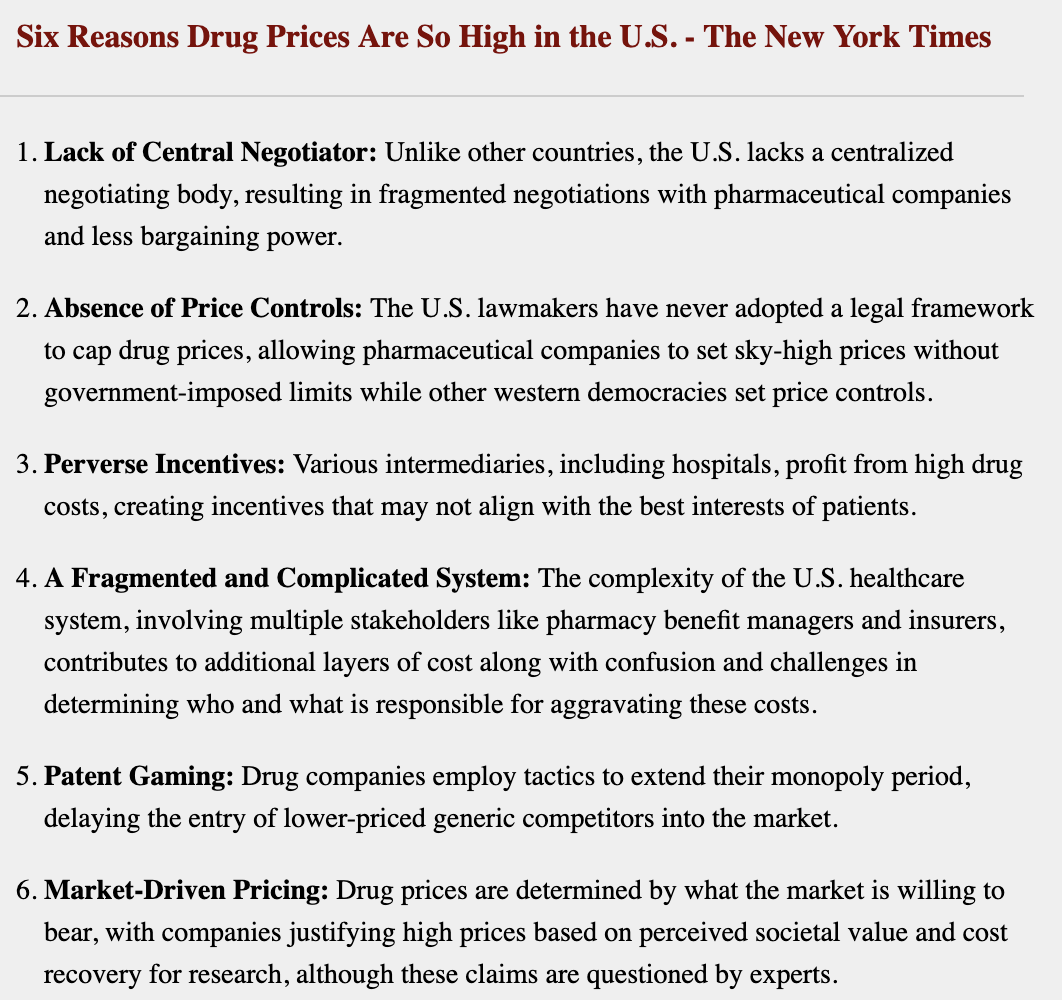
As I followed the headline above, I realized it was published in the New York Times and they refuse to let you read it unless you subscribe which in turn creates a fee structure that I don’t enjoy. So what follows here are what I found that that support the argument that we as consumers are being manipulated to either pay exorbitant prices for our drugs or by extension, pay exorbitant premiums to our insurance companies.
The net outcome is that while access to these drugs keeps us healthy for longer, we as citizens of this country and paying far more to achieve that outcome that most other countries on the planet.
Yes, there is legislation now in place to allow Medicare to negotiate for lower prices. But the benefits for most of us may not appear for many years if ever. If we don’t remain alive, we will never stop paying too much. Keep in mind that efforts were made some years ago but was shut down by Wall Street’s influence on our elected representatives in Washington.
How can you minimize your costs — and what state or national steps could make a difference?
By Robert H. Shmerling, MD, / Harvard Health Publishing; Editorial Advisory Board Member January 18, 2024 / http://tinyurl.com/mrxx2hft
I was in line at a pharmacy recently as the customer ahead of me was picking up her prescription. The pharmacist matter-of-factly said: “that’ll be $850.” All she could say was “really?” She left without her prescription, telling the pharmacist she’d have to call her doctor about a less costly alternative.
Many of us routinely experience sticker shock over drug costs. And ever more dramatic examples suggest there’s no limit. So, let’s talk about ways to minimize what we spend on prescription drugs; how we got to this juncture where some medicines cost more than a million dollars per dose; and what changes are needed in our pricey medication-industrial-complex.
7 ways to minimize your spending on prescription drugs
Consider these seven strategies to pare drug costs. Savings will vary depending on insurance, donut holes, deductibles, and cost-sharing.
- Ask your healthcare provider three questions: Is every medicine you take truly necessary? Is it safe to reduce the dose of any medicines you take? Could a lower-cost or generic drug be substituted?
- If you have health insurance, check the list of preferred medications (the formulary), which tend to cost less than other similar medicines.
- Split pills: In some cases, a prescription will cost less if each pill contains more than your needed dose and can be divided. For example, if you usually take a 25-mg pill, taking half of a 50-mg pill may help you save on drug costs and copays. Ask your pharmacist if the math works for you.
- Ask if a 90-day supply rather than a 30-day supply would reduce copays.
- Look for prescription drug discount programs that offer savings. Restrictions apply and availability varies by location. Also, paying through a discount program might not count toward your insurance deductible or maximum out-of-pocket costs, so it isn’t always less expensive to use these programs.
- Compare prices at different pharmacies and review your options with a pharmacist. Sometimes the price is lower if you don’t use your insurance.
- Consider using an online mail-order service (such as Blink Health or Cost Plus Drug Company). However, spending through these sites may not count toward your insurance deductible. And the prices are not always lower online.
These measures will help some people more than others and can take up a lot of time. The sad truth is that even if you did everything you could, the impact on your wallet might be small.
Why are medicine costs so high in the US?
My top five contenders are:
Drug makers’ profit motive. Pharmaceutical companies routinely reject this idea. They say it’s expensive to develop new drugs and run the required clinical trials to prove safety and effectiveness. Many promising drugs fail, and the FDA drug approval process is difficult and costly.
Yet one recent study published in JAMA Network Open found no connection between how much a drug company spends on research and development (R&D) for a drug and the drug’s price. Even after accounting for R&D spending, most of the top 30 pharmaceutical companies make billions of dollars in profit. And in Europe, where drug prices are negotiated, the very same drugs made by the same companies for the same health problems typically cost far less than in the US.
Pharmacy benefit managers (PBMs) handle drug benefits for large employers, Medicare, and health insurance companies. PBMs negotiate prices with health insurers and pharmacies. They help decide which drugs to cover and how much patients pay. Their fees and incentives — often a share of total spending on medicines, which might encourage approval of higher-priced drugs — contribute to the costs health consumers wind up paying. A flurry of state and federal legislation is intended to limit what PBMs can do and the transparency of their operations.
Cost-sharing. In recent years, insurers have increasingly shifted costs to patients through higher copays, deductibles, and premiums. Sometimes this is justified by the notion that this incentivizes patients to seek care only when truly necessary; of course, it could also discourage people from seeking care even when warranted.
Legal maneuvers. Many drug makers file numerous patents and sue potential competitors to extend their time holding a monopoly on a particular drug (see example). Or they create “me too” drugs by slightly tweaking an existing drug so they can patent it as a brand-new drug. Some pharmaceutical companies acquire patents for older drugs and then jack up the price. Others have bought or merged with another drugmaker to avoid price competition.
Direct-to-consumer advertising. Drug companies spend billions on ads (nearly $8.1 billion in 2022). Marketing costs raise the price of drugs while boosting demand for newer, heavily promoted drugs. Advertised drugs tend to be far more expensive (and not always better) than older drugs. Perhaps this is why such advertising is banned in most other countries.
What might slow rising drug costs?
Although prescription drug prices are likely to remain high for the foreseeable future, three developments could help slow rising drug prices in the coming years:
- The Inflation Reduction Act of 2022 allows the US government to negotiate drug prices for Medicare, which is expected to lower drug costs. The first 10 price-protected drugs — including the blood thinner apixaban (Eliquis) and the diabetes medicine sitagliptin (Januvia) — take effect in 2026. More drugs will be added to this list each year. If you’re on one of these drugs, the impact could be large. But with more than 20,000 approved drugs on the market, it’s not a solution that will help everyone.
- Recent FDA action allowing Florida to import drugs from Canada, and other proposed federal and state legislation aiming to protect people from high prescription drug prices.
- Organizations advocating for lower prescription drug prices, including AARP, Consumers Union, and Patients for Affordable Drugs, appear to have the attention of lawmakers as never before.
The bottom line
Let’s face it: our complex, broken healthcare system incentivizes those who develop and distribute drugs to set the prices well above what many can afford. And the amount you can chip away on your own is limited. What we really need is an overhaul to remove middlemen who contribute to added cost without always adding value.
Until we get there, do what you can, even if the impact is small. Trying your best to stay healthy could be the most important step you take. After all, the best way to limit how much you spend on prescription drugs is to have no reason to take them.
 Helping Define Your Financial Future
The author completely misses the boat here. He says they spend a ton on advertising. Do you know why? Not to advertise a drug (my doc says no patient has ever seen a commercial and then come in and ask about a drug). They do it to control the news. Networks receive half of their revenue from big pharma.
So…..do you think big pharma wants you HEALTHY?
The best way to reduce health care costs is simple. Eat real food. Anything with a label most likely has something that poisons you long term. Ignore the food pyramid; that’s as corrupt as big pharma.
And exercise. It always amazes me when someone looks at incredible government corruption and incompetence…..and immediately screams for more government intervention.
LikeLike
Tony – why do you bother following my posts since you have a criticism for virtually every one of them. Just know I’ve been a professional in the money business since 1978, owned my own RIA, have dozens of clients still on the books, none of which have ever complained about my thoughts. I wish you well but know that I usually don’t read your comments and instead simply delete them from my desktop.
LikeLike
Your readers deserve to know another side, don’t you agree? If you disagree with my posts, why don’t you counter them? Don’t you think your readers would benefit?
LikeLike